Trusted AI Platform

AI you can trust
in production.

Everything needed to run AI securely: Unity Catalog governance across every data and AI asset, AI Gateway controlling model requests, structured evaluation, monitoring, and deployment paths built for audit rather than for a demo.
The Problem

The fastest way to lose executive trust in AI is to run a system nobody can explain.

This is the part of AI delivery most vendors skip, because it is unglamorous. In regulated industries "it works" was never the bar. The bar is: who can access what, why did the model answer this way, can we prove it, and can we shut it down cleanly if something goes wrong.

Teams that skip this layer usually don't find out until an auditor, a regulator, or an incident finds it for them. By that point the question is not whether to add governance. It is how much of the system has to be rebuilt to accept it.
Our Approach

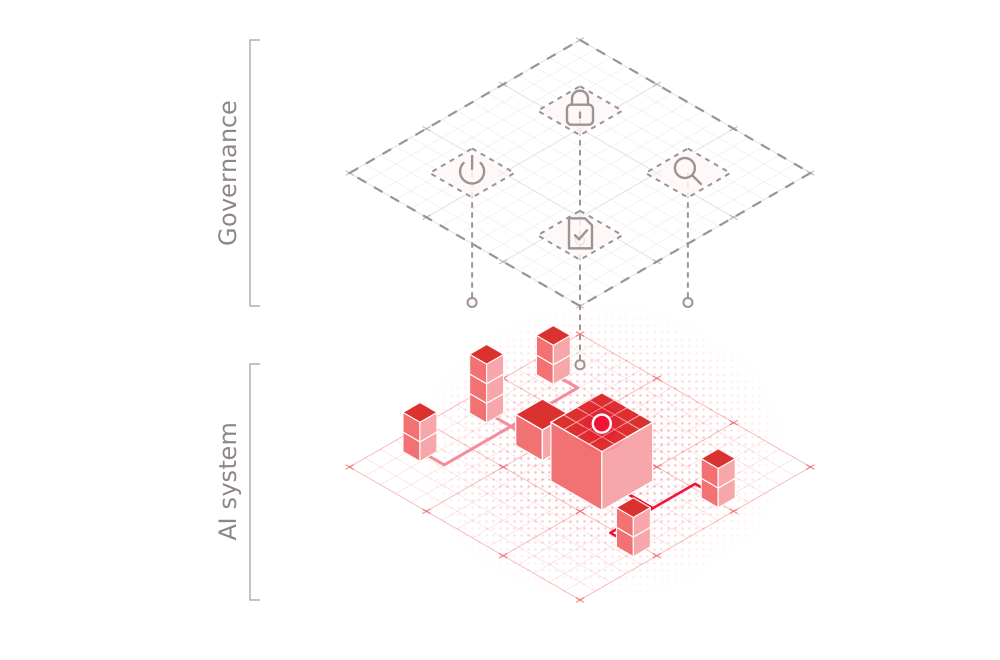
Governance as a first-class part of the platform

This comes directly from where we have spent most of our delivery time: highly regulated, data-intensive sectors including financial services, manufacturing, and energy, where operating under real regulatory and operational constraint is the default rather than the exception.

We design AI platforms so that every model call, every data access, and every agent decision is logged, governed, and explainable, using Databricks' native governance tooling rather than a patchwork of third-party bolt-ons.

01

Native tooling

Unity Catalog, AI Gateway, and the platform's evaluation tooling do the governing. That matters because every third-party bolt-on adds a second permission model, a second audit trail, and a second thing to keep in sync. Governance that lives in the platform stays correct without maintenance effort.

Unity Catalog
AI Gateway
One permission model
02

Governance that speeds delivery up

Clear governance frameworks remove the ambiguity and risk-aversion that stall AI projects in the first place. Most of the delays we see are caused by the absence of governance rather than its presence: teams waiting for a decision nobody is empowered to make.

Defined ownership
Fewer approval loops
Faster sign-off
03

Retrofit is a normal, solvable job

We regularly add Unity Catalog, access controls, and evaluation onto AI deployments that were built without them. It is one of the most common situations we walk into and it does not require starting again.

Existing systems
Layered rollout
No rebuild required
The Foundation

One platform.
The full AI stack.

Every AI system we build lives entirely on Databricks. The data the models train on, the pipelines that feed them, the models themselves, and the operational layer that runs them in production are all governed, monitored, and maintained in one place.
Data and AI on one foundation.
Databricks unifies the data layer and the AI layer. Delta Lake governs the training data. Unity Catalog applies the same access controls to the data the models see as to the data the business sees. MLflow tracks every experiment and model version. The foundation powering the AI is the same one the rest of the platform runs on, so there is no extract and reload step between analytics and ML.
Real-time AI at production speed.
Databricks Lakebase, managed PostgreSQL inside the platform, provides the transactional, low-latency operational layer production AI requires. No separate operational database to stand up and no fragile sync between analytical and operational state. Live model output, journey state, and trigger events are all managed in milliseconds inside the same governance perimeter as everything else.
Conversational access, still governed.
Databricks Genie gives business users natural-language access to AI outputs and the underlying data without writing SQL or switching tools. Scoped by Unity Catalog, auditable by design, access-controlled to role. The same governance that protects production data also governs which questions each user can ask.
What's Inside

Components to be implemented

Not every engagement needs all seven. An assessment establishes which of these you already have, which are partly in place, and which are missing.
01
Unity Catalog
Unified governance across every data and AI asset on your platform, so access permissions, data lineage, and discovery work consistently whether someone is querying a table or calling an AI agent. We implement Unity Catalog as the governance backbone for your entire AI estate, giving you end-to-end governance from raw data through to agent output.
02
Governance
Policies and controls that make AI usage auditable by design: who can deploy a model, who can query it, what data it is allowed to touch, and how decisions get reviewed. We help you define and implement frameworks that satisfy both your internal risk teams and external regulators without slowing delivery to a crawl.
03
AI Gateway
A central, secure layer for routing and controlling every AI model request across your organisation. Instead of model access sprawling across shadow tools and unmanaged API keys, every request is logged, rate-limited, and controlled from one place. This becomes critical the moment you are running more than a single pilot.
04
Security
Access controls and data protection engineered to meet the enterprise and regulatory bar rather than survive a sales demo. Encryption, identity integration, and network isolation designed into the architecture, so AI systems meet the same standard as the rest of your sensitive infrastructure.
05
Evaluation
Quality measurement that goes beyond gut feel. Agent-as-a-Judge automatically analyses an agent's reasoning trace and scores relevant parts of its output. Tunable Judges let domain experts define what good actually means for legal compliance, factual accuracy, or business tone.
06
Monitoring
Ongoing visibility into how AI systems behave once they are live: performance, cost, drift, and anomalies. Problems get caught before they become incidents, and you have a clear audit trail when stakeholders ask what happened and why.
07
Deployment
Reliable, repeatable paths from validated model to live production system, with version control, staged rollout, and rollback built into the process rather than improvised under pressure during an incident.
How It Works

From visibility to governance, step by step.

The same four stages whether you are governing an existing AI estate or building the foundation before the first system goes live.
step 01
Scope
Define the use case, the success metrics, and the data sources. If the use case is not yet chosen, this runs as an AI Strategy and Advisory engagement first.
step 02
Architect
Design the solution on Databricks, with governance and evaluation designed in at this stage rather than added at the end. Reviewed and signed off before build begins.
step 03
Build
Iterative development with regular checkpoints. Data pipelines, retrieval and agent logic, integrations, and the surfaces your users will actually touch.
step 04
Evaluate
Structured, measurable evaluation against real quality criteria before anything reaches production. Automated judges score outputs against criteria your domain experts define.
step 05
Deploy and Enable
Production rollout paired with knowledge transfer, so your team can operate and extend the system independently. Monitoring, escalation paths, and ownership are defined before go-live.
Good to Know

Common questions before getting started.

What is a Trusted AI Platform, and why do we need one?

A Trusted AI Platform provides the technical foundation and controls needed to run AI securely, reliably, and responsibly at scale. It brings together data governance, model access management, security, evaluation, monitoring, and deployment processes. Instead of managing these separately for every AI application, you establish consistent standards across your organisation, making AI easier to operate, audit, and scale.

How does Unity Catalog help secure our AI applications?

Unity Catalog provides centralised governance for data and AI assets within Databricks. It helps control who can access sensitive information, manage permissions, track data lineage, and apply consistent governance policies. We configure these capabilities around your organisation's security requirements, helping ensure AI applications only access the data they're authorised to use.

What is Databricks AI Gateway, and how can it help control AI usage and costs?

Databricks AI Gateway provides a centralised way to manage access to AI models and monitor their usage. Depending on your configuration, it enables capabilities such as request tracking, rate limiting, and usage controls. We help you implement these capabilities so you can improve visibility into AI consumption, manage costs, and maintain oversight as adoption grows across teams.

Will adding governance slow down our AI development?

Not when it's designed properly. In fact, clear governance can remove many of the approval bottlenecks that delay AI projects. By establishing consistent access policies, deployment standards, evaluation criteria, and responsibilities upfront, teams can work within defined boundaries instead of negotiating security and compliance requirements for every new use case.