
Architecture Design & Review
Independent technical review on your Databricks architecture
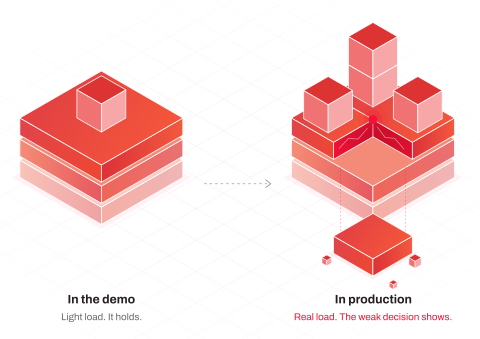
Architecture decisions made under pressure don't always hold up under load.
Inherited architecture
You took over a production system with no one left to explain the decisions behind it. It works today. Whether it holds as you scale is the open question, and answering it takes an expert look at the design.
Pre-build validation
A major build is planned. The architecture is defined. Before the team starts, an independent technical review could catch the decisions that are expensive to undo mid-build.
Best practice evolves
Best practice on Databricks evolves with the product. Features and capabilities exist now that weren't available when your architecture was set. A review identifies where those would simplify the design or cut the cost of running it.
Every layer of the platform. From ingestion to consumption.
Data Architecture & Modelling
Review of table design, medallion architecture implementation, Delta Lake usage, and data modelling decisions across the Bronze, Silver, and Gold layers. Covers the decisions that determine query performance, pipeline reliability, and long-term maintainability.
Ingestion & Pipeline Review
Assessment of ingestion patterns, batch and streaming architecture, pipeline dependencies, and error handling. Identifies structural inefficiencies that surface as latency, unreliability, or runaway compute at scale.
Unity Catalog & Governance
Review of Unity Catalog structure, access control design, data lineage setup, and governance model. Covers the decisions that are difficult and disruptive to restructure after initial implementation.
Compute & Cost Architecture Review
Analysis of cluster configuration, job scheduling, autoscaling behaviour, and compute allocation patterns. Maps actual spend against architectural intent and identifies where costs are structurally inflated rather than operationally excessive.
Security & Access
Assessment of network topology, credential management, data access patterns, and compliance with security requirements. Covers the structural decisions that determine the platform's risk profile under audit.
Target Architecture Design
Where a platform is being designed rather than reviewed, we produce a target architecture scoped to your use cases, team capabilities, and technical constraints with key decisions documented, trade-offs named, and rationale transparent.
Findings you can act on. Not a report to file away.
A structured review of the platform areas in scope, covering what was found, why it matters, and how significant the risk or inefficiency is. Findings are categorised by priority, what needs attention before the next stage of scale, and what can be addressed in the normal course of work.
For each material finding, a specific remediation recommendation: what to change, how to approach it, and what it unblocks. The list is prioritised by impact and effort so your team can sequence the work without another planning exercise.
For design engagements, a documented record of the key architectural decisions made, the options considered, and the rationale for each choice.
Findings are walked through with your technical leadership in a structured session, not handed over in a document and left to be interpreted. Questions are answered, edge cases discussed, and the team leaves with shared understanding of what to do next and why.