Build & Migrate Your Platform

Move to Databricks.
Build what comes next.
We migrate workloads from Snowflake, Azure Synapse, Oracle, and legacy on-prem warehouses to Databricks, and build production-ready Lakehouse platforms from the ground up. End-to-end. Designed for AI from day one.
WE'VE SEEN THIS BEFORE.

Data platforms don't fail overnight. They fall behind slowly.

The organizations we work with aren't running broken systems. They're running systems that were right five years ago. The data volumes outgrew them. The AI ambitions exceeded them. The costs kept climbing. And the longer the migration is delayed, the wider the gap between what the platform can do and what the business needs it to do.
Any of these sound familiar?
PLATFORM NOT SCALING
"The warehouse handles today's workloads. It can't handle tomorrow's."
Data volumes are growing faster than the platform can absorb. Queries that took seconds now take minutes. Adding capacity means adding cost, and the architecture is not flexible enough.
AI BLOCKED BY INFRASTRUCTURE
"We have AI use cases ready. The platform can't support them."
The business case for AI is clear. But the current stack wasn't built for the governance and tooling AI requires.
RISING COST, FLAT VALUE
"We're spending more every quarter and getting the same out of it."
Licensing fees, fragmented tooling, and inefficient compute keep eating into the budget without adding real value. The business is paying for complexity, not capability.
HOW WE BUILD

The right strategy for where you're going. Not a one-size-fits-all playbook.

Every migration starts with discovery: understanding your data, workloads, and the business outcomes your platform needs to enable. From there, we choose the right strategy for each workload: a fast lift-and-shift where speed and cost matter most, a full re-architecture where it's time to modernize, or a hybrid of both across your estate. Then we migrate, validate for production readiness, and hand over a platform your team can operate.

01

Architecture-first.

We design the target Lakehouse architecture before a single pipeline is moved. Data flows, governance model are defined upfront. The architecture is the deliverable that everything else is built against.

Target architecture
Governance design
02

Production-ready

We validate every migrated workload against real production data, so correctness, scale, and reliability are proven rather than assumed.

Workload validation
Production-grade
03

Your team runs it after we leave.

The platform we build is the platform your team operates. Documentation, runbooks, and operational enablement are built into every engagement. When we hand over, your team has the skills and context to maintain, extend, and evolve what was built.
Operational handover
Documentation
Team enablement

MIGRATION

Move off Snowflake, Azure Synapse, Oracle, or any legacy on-prem warehouses to Databricks.

Full workload migration: code, logic, data, and pipelines. We re-architect where the source system's patterns don't translate cleanly to a Lakehouse architecture, rather than forcing legacy structures into a new environment.
Learn more about Migration
Packages
Snowflake to Databricks Migration PoV
A scoped proof-of-value engagement. We migrate a representative workload from Snowflake to Databricks to validate feasibility, performance, and cost impact before committing to a full migration.
View package
Unity Catalog Reference Migration
Migrate from Hive metastore to Unity Catalog, along with your existing governance setup. Includes access controls, lineage setup, and cross-workspace configuration aligned to your security and compliance requirements.
View package

Platform Buildout

Design and implement a production-ready Databricks Lakehouse.

A new Lakehouse, designed from the ground up. Security and governance are built in from the start, and the platform is sized for both your current workloads and your AI roadmap.
Learn more about Platform Buildout
Packages
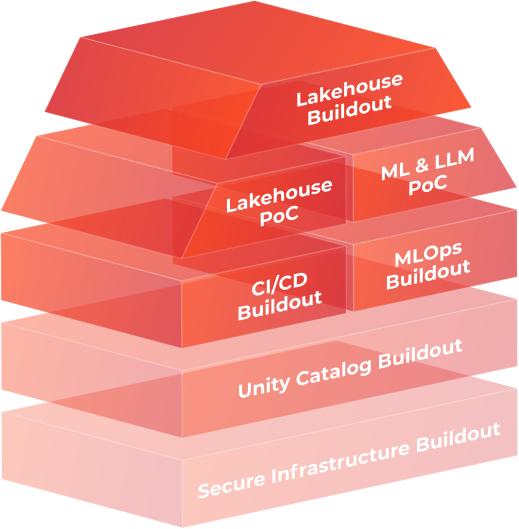
Lakehouse Buildout
Full architecture, Terraform infrastructure, medallion pipelines, CI/CD, Unity Catalog governance, and team enablement. Everything your team needs to operate, extend, and evolve the platform independently, delivered and handed over in four months.
View package
Databricks Lakehouse PoC
End-to-end ingestion, transformation, Gold layer KPIs, Databricks SQL Warehouse, and a dashboard — built on your actual use case. Not a template. Not a sandbox. Your data, your metrics, working.
View package
Secure Infrastructure Buildout
Three-environment infrastructure design (dev/staging/prod) on Azure or AWS, built with Terraform, aligned to your security and compliance requirements. Deployed in a few weeks with IaC your team can extend.
View package
CI/CD Buildout
End-to-end CI/CD pipeline buildout - testing, staging, and production deployment - standardised for your Databricks environment. Your team runs it independently after handover.
View package
THE ENGAGEMENT

Structured to deliver.
Not to stall in discovery.

Every platform engagement starts with a technical assessment and ends with a production handover. The scope is defined upfront, the milestones are measurable, and your team is involved throughout so they can operate what we build.
01
Assess
We review your current platform, data landscape, and workloads. The output is a migration or buildout roadmap with clear scope, sequencing, and risk assessment.
01
Design
Target architecture design: cloud infrastructure, data flows, governance model, security, and CI/CD. Reviewed and approved before any build begins.
01
Build
Implementation against the approved architecture, with every component built and tested to production standards.
01
Validate
Every workload is tested against production data and your SLAs before anything goes live, so your team can cut over with confidence.
01
Hand over
Your team can run, maintain, and extend the platform independently by the time the engagement finishes.
Migrations delivered
20+
Typical project duration
6-9 months
of Databricks expertise
10+ years
Ready to talk?
Talk to an expert
Results

What platform projects deliver in practice

TechnoAlpin

From snow guns to smart systems: TechnoAlpin’s data transformation with Datapao

When we ski down a perfectly groomed slope in the early morning, we rarely think about the streams of data pulsing behind the scenes.
Timeline
Unified data platform live in under 12 weeks
Enablement
Internal team fully enabled to operate independently
Performance
60% reduction in pipeline processing time
Read the whole study
Manufacturing
Good to Know

Common questions before getting in touch.

Migrating to Databricks or building a new Lakehouse is a significant decision. Here are the answers to the questions we hear most often from teams planning their next move.

Which platforms can you migrate to Databricks?

We help organizations migrate from Snowflake, Azure Synapse, Hadoop, Oracle, SQL Server, and legacy on-premises data warehouses to Databricks. We cover the entire migration, including data, SQL logic, pipelines, workflows, and governance. Where needed, we also redesign workloads to take full advantage of the Databricks Lakehouse architecture rather than simply replicating the old platform.

Do we need to migrate everything to Databricks at once?

No. In many cases, a phased migration is the smarter approach. We identify which workloads should move first based on business value, technical complexity, and dependencies. Your existing platform can continue operating while workloads are progressively migrated and validated, reducing disruption and risk.

Can you build a Databricks Lakehouse from scratch?

Absolutely. We design and implement production-ready Databricks Lakehouse platforms on Azure and AWS, including cloud infrastructure, data ingestion, transformation pipelines, Unity Catalog governance, security, and CI/CD. Everything is designed around your actual workloads, business requirements, and future AI ambitions.

What happens after the migration or platform build is complete?

You get more than a working platform. We provide documentation, operational runbooks, and hands-on knowledge transfer so your internal team can manage and extend the solution independently. If you need ongoing support, optimization, or additional engineering expertise, we can help with that too - but long-term dependency is never the goal.