
Applied LLM on Databricks
A governed RAG solution on Databricks, built on your Delta Tables and deployed in fixed scope.
What the solution delivers for your organisation
Increase developer productivity
Developers query the LLM directly rather than building bespoke retrieval logic, the pipeline handles ingestion, embedding, and serving.
Built on top of your own Delta Tables
No separate data store. The LLM retrieves from your existing Delta Tables, governed by the same Unity Catalog policies as the rest of your Lakehouse.
Reduce time to market
A fixed-scope engagement with defined phases and deliverables gets the application into production without open-ended discovery.
Improve security by keeping your data and model in-house
The entire stack runs inside your Databricks managed environment. No proprietary data passes through an external API.
Easily monitor the performance of your LLM solution
Automated monitoring is part of the delivery, not a later addition. Response quality and usage patterns are tracked from day one.
Reduce total cost of ownership (TCO)
Running the solution on your existing Databricks infrastructure avoids the cost of standing up and maintaining a separate AI stack.
High-level RAG LLM architecture on Databricks
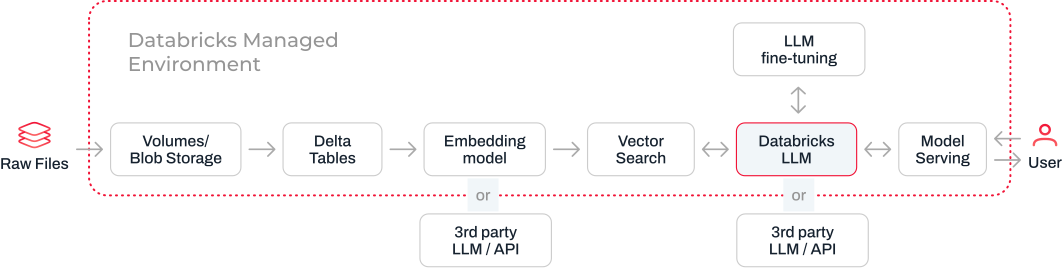
From strategy to a monitored, deployed LLM.
We assess your knowledge base, define the use case, select the model approach (RAG, fine-tuning, or hybrid), and confirm the architecture. Model selection - Databricks-native, Hugging Face, or third-party API - is locked here based on your data type, volume, and governance requirements.
End-to-end build of the LLM application: data preparation, embedding pipeline, vector search setup, RAG architecture or fine-tuning, and Q&A layer integration. Tested against your data and use case before moving to serving.
Deployment into your Databricks workspace via Model Serving - a managed, scalable endpoint accessible to your applications and users. Access-controlled through Unity Catalog. Internal teams are involved throughout.
Monitoring dashboard and automated alerting configured to track query performance, response quality, and usage volume. Baseline metrics set. Refresh and retraining triggers defined.