Migration

Move off your current platform to Databricks. Without the risk.

We migrate workloads from Snowflake, Azure Synapse, Microsoft Fabric, Oracle, and legacy on-prem warehouses to Databricks. Where the old patterns don't fit a Lakehouse, we re-architect rather than carry existing problems onto a new platform. Every workload is tested against production data and your SLAs before cutover.
WE'VE SEEN THIS BEFORE.

Migration risk is real. Most of it comes from how the migration is run.
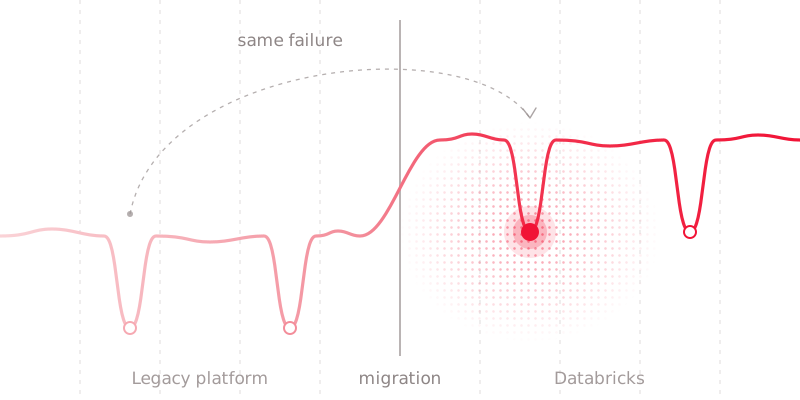
The decision to migrate to Databricks is usually sound. The complications come from treating it as a technical translation exercise: moving schemas and queries across without adapting them to how Databricks works best.
Any of these sound familiar?
The Lift-and-Shift Trap
"We migrated to Databricks. The platform is faster, but the pipelines still break the same way."
A new platform won't fix problems that come from how the old system was built. If the current design makes changes slow, upgrades painful, or pipelines fragile, moving it across as it is brings those same issues along. Lasting improvement comes from modernising the patterns, not just changing the platform.
Cutover Risk
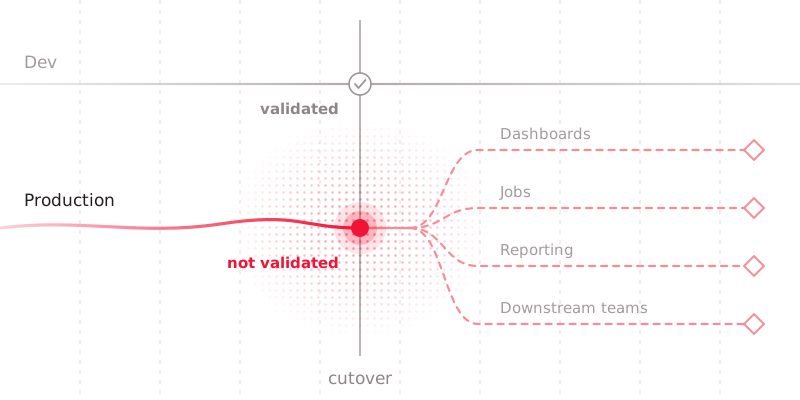
"We can't afford a failed cutover. The business runs on this data."
The whole business depends on a production platform. When jobs fail or dashboards go blank, the teams using them lose trust. Without thorough validation before cutover, these issues only surface once people are already relying on the new system.
Accumulated Complexity
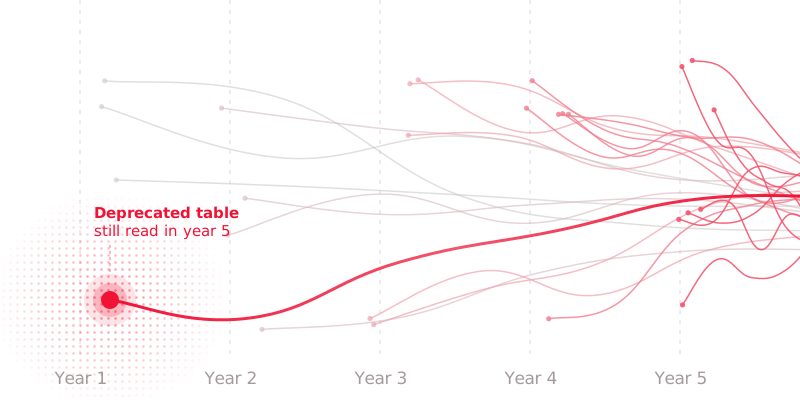
"There are five years of SQL logic in this warehouse. Nobody fully understands all of it."
Legacy platforms accumulate technical debt over time, undocumented transformations, deprecated tables that something still reads, edge-case logic that was never written down.
The Approach

Lift and shift or re-architect, depending on what you need.

Every Datapao migration starts with understanding your current setup, not with migrating code. We look at how your workloads are used, what's working well, and what you need from Databricks. Based on that, we recommend whether to move things across as they are, re-architect them, or combine both.

01

Architecture-first. Not code-first.

Target architecture, data flows, Unity Catalog structure, and governance model are designed and approved before migration begins. The design is based on what you need from Databricks, whether that means keeping existing patterns or re-architecting them.

02

Migrated in sequence. Not all at once.

Every migrated workload is tested against production data volumes and against your actual SLAs, not synthetic test data. Performance, cost, and correctness are verified at production scale before cutover. What goes live has already proven it can hold.

03

Owned by your team. Not dependent on us.

When we're done, your team can operate, extend, and troubleshoot the platform on their own. Knowledge transfer happens throughout the engagement, and the handover includes the runbooks and documentation they'll need.

The migration Process

From your current platform to Databricks

  1. 01Assess
  2. 02Architect
  3. 03Migrate
  4. 04Validate
  5. 05Hand Over
Your team is involved throughout, with knowledge transfer at every step.
The Engagement

Structured to deliver.
Not to stall in discovery.

Every migration starts with understanding your current setup and ends with a production handover. The milestones are measurable, and your team is involved throughout, so the platform already feels familiar by the time it's handed over.
01
Assess

A thorough review of your current setup: schemas, pipelines, data volumes, usage patterns, and dependencies. The output is a migration roadmap with clear scope, sequencing, workload prioritisation, and risk assessment.

02
Architect

Target Lakehouse architecture design: ingestion patterns, data flows, Unity Catalog structure, governance model, and security controls. Reviewed and approved before migration begins.

03
Migrate

Workloads move to Databricks in prioritised phases, following the approved architecture. Each phase covers pipelines, transformations, data, and access controls, and is signed off before the next begins.

04
Validate

Every migrated workload is tested end to end and signed off with your team before go-live. Anything that needs attention is resolved first, so cutover can go ahead with confidence.

05
Hand Over

Production cutover, carried out together with your team. Runbooks and operational documentation build on the knowledge transfer that's happened throughout the engagement. When we're done, your team can operate, extend, and troubleshoot the platform on their own.

Results

What migrations deliver in practice

TechnoAlpin

From snow guns to smart systems: TechnoAlpin’s data transformation with Datapao

When we ski down a perfectly groomed slope in the early morning, we rarely think about the streams of data pulsing behind the scenes.
Timeline
Unified data platform live in under 12 weeks
Enablement
Internal team fully enabled to operate independently
Performance
60% reduction in pipeline processing time
Read the whole study
Manufacturing
Migration Packages

Two focused migrations.
One standard of delivery.

Whether you're evaluating a move from Snowflake or already on Databricks and moving from Hive metastore to Unity Catalog, each package is scoped to your situation. Both follow the same delivery methodology.
Proof of Value

Snowflake to Databricks Migration PoV

A scoped migration of a representative workload from Snowflake to Databricks, designed to validate feasibility, quantify performance and cost differences, and give your leadership a concrete basis for the full migration decision.
What's included
  • Workload selection and assessment
  • Architecture design for the migrated workload on Databricks
  • Migration of selected pipelines, transformations, and data
  • Performance and cost comparison against the Snowflake baseline
  • Findings report with full migration roadmap
Who it's for
Teams that have Databricks on the roadmap but need internal buy-in before committing to a full migration. The PoV de-risks the decision with real data from your environment.
View package
Governance Migration

Unity Catalog Reference Migration

Migration from Hive metastore to Unity Catalog, along with your existing governance setup. Covers access control design, cross-workspace setup, and updating your workflows so they're Unity Catalog ready, all aligned to your security and compliance requirements.
What's included
  • Assessment of current metastore structure and governance model
  • Unity Catalog architecture design (namespaces, access controls, lineage)
  • Migration of existing tables, views, and permissions
  • Cross-workspace configuration and identity federation setup
  • Governance documentation and operational runbook
Who it's for
Organisations already running Databricks - or mid-migration - that need to establish or migrate their governance layer correctly before the next phase of work.
View package

Building a Lakehouse from the ground up instead?

Platform Buildout covers Databricks Lakehouse implementation for organisations with no existing platform to migrate, or those that would rather start fresh.