Databricks Agent Bricks explained: What it does, how it works, and where it’s going next
Datapao
December 5, 2025
If you’ve worked in enterprise AI for long enough, you know this story: A team builds a generative AI proof of concept. It looks promising. Everyone’s excited. And then the pilot quietly disappears, not because it failed, but because scaling it responsibly turned out to be too complex, too risky, or too expensive.
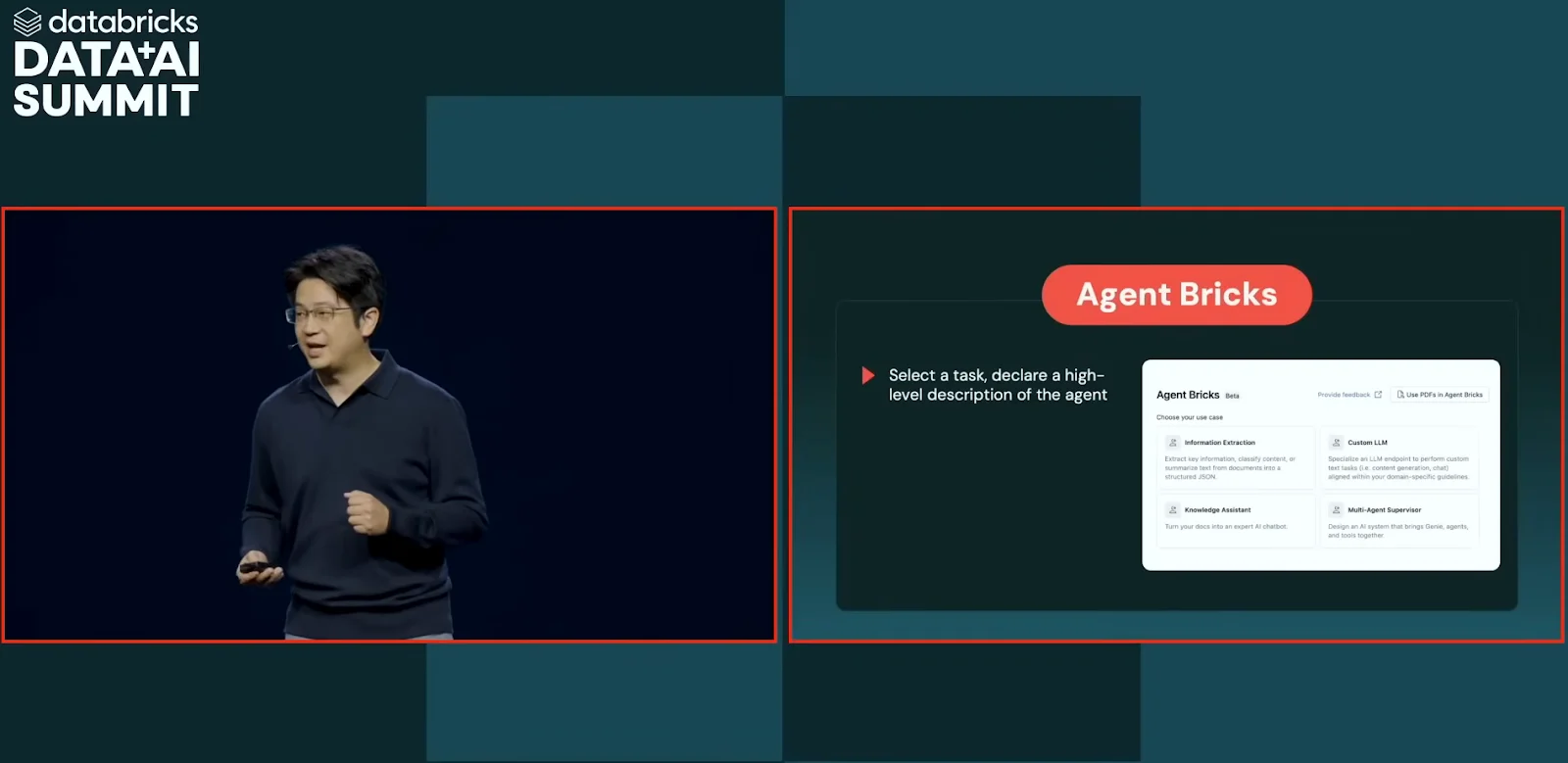
Databricks Agent Bricks (still in Beta) feels like Databricks’ direct response to that recurring story. It’s a framework for designing, evaluating, and deploying AI agents directly within the Databricks Lakehouse, where your data, governance, and cost controls are already in place.
It doesn’t promise “AI without engineers.” It promises AI without chaos.
And that’s a much more realistic kind of magic.
The real problem Agent Bricks is trying to solve
Most AI projects don’t fail because of bad models. They fail due to poor structure, unclear evaluation, unscalable architecture, fragmented tools, or weak governance.
Agent Bricks takes a structured, almost architectural approach to that problem. Built on the Mosaic AI research stack, it provides data and AI teams with a governed, repeatable approach to transition from “we have an idea” to “we have a production agent.”
Think of it as an integrated agent factory:
You describe your task (“extract contract data,” “summarize field reports,” “build an internal Q&A assistant”).
And Agent Bricks automates the rest: generating training data, building evaluation judges, testing model configurations, and deploying governed endpoints with traceable performance metrics.
In short: it takes the parts of AI development that slow everyone down, and automates them in a way that’s transparent instead of “mysterious”.
Making PDFs usable
One of the most quietly transformative parts of Agent Bricks is something deceptively simple: PDFs.
Yes, PDF parsers have existed for years, but they’ve always come with friction: external libraries, brittle scripts, third-party APIs, unpredictable performance, and a lot of Python glue code.
Databricks’ new ai_parse_document() function, built directly into Agent Bricks and fully governed by Unity Catalog, removes all of that. You can now parse layout-heavy, unstructured documents with plain SQL, no package installs, no external services, no secrets, no brittle OCR pipelines. Just a single function call, inside your existing lakehouse.
And it’s fast. According to Databricks’ internal benchmarks, the new document intelligence pipeline delivers state-of-the-art speed and throughput at a cost point far below typical third-party document-processing APIs.
Despite decades of OCR and NLP advances, 80% of enterprise knowledge is still locked in PDFs, slide decks, contracts, and scanned documents that analytics and AI systems simply cannot use. Databricks’ approach changes this by extracting structured data (including tables, merged cells, diagrams, and captions) directly into Delta tables while preserving spatial relationships for multimodal or RAG applications. With Agent Bricks, what used to be dormant, inaccessible data becomes queryable, auditable, and reusable without ever leaving the Databricks platform.
Smarter evaluation in Databricks Agent Bricks
The second big innovation inside Agent Bricks is how it handles evaluation, the least glamorous but most essential part of AI.
Measuring an LLM’s quality has always been tricky. Accuracy and BLEU scores don’t mean much when the model’s output is a reasoning process, not a simple answer.
Databricks tackled this by introducing Agent-as-a-Judge, Tunable Judges, and Judge Builder, three new features that turn evaluation from a subjective art into a measurable, auditable science.
Agent-as-a-Judge automatically analyzes the agent’s reasoning trace and scores relevant parts of its output.
Tunable Judges let domain experts define what “good” means, whether that’s legal compliance, factual accuracy, or business tone.
Judge Builder offers a no-code interface for creating, adjusting, and visualizing these evaluators.
The result? A world where “it seems to work” finally gives way to “we know how it performs.”
For regulated industries like finance or healthcare, that’s not just nice to have, it’s essential.
The technical flow: from definition to deployment
Behind all the simplicity is a surprisingly elegant workflow. Here’s what happens under the hood:
Define the task and connect data You configure the agent (for example, “extract key terms from legal PDFs”) and link it to files or tables in Unity Catalog. Supported formats include txt, pdf, md, ppt/pptx, and docx.
Generate synthetic data and benchmarks Agent Bricks automatically creates synthetic samples and evaluation sets to measure groundedness, accuracy, and relevance.
Optimize configuration It runs experiments across various model types, prompt structures, retrieval parameters, and cost targets, allowing you to choose whether to prioritize cost or quality.
Deploy and monitor The system deploys governed endpoints integrated with Unity Catalog (for access control) and MLflow Tracing (for evaluation and lineage). Endpoints scale to zero after inactivity to reduce cost.
This structured loop: build, measure, optimize, deploy – is what allows AI agents to move from prototype to production without breaking everything else in your stack.
The strengths of Agent Bricks you’ll actually feel in practice
Here’s where Agent Bricks starts to show real-world impact:
Speed: Reduces agent development time from weeks to hours by automating experimentation and deployment.
Governance by design: Unity Catalog governs access, lineage, and audit logs out of the box.
Smarter evaluation: Built-in judges remove the guesswork from quality measurement.
Document intelligence: The PDF parser unlocks decades of inaccessible enterprise content.
Cost predictability: Optimization workflows help balance quality and spend before deployment.
Accessible to everyone: Agents can be created and tested directly from the Databricks UI, no notebooks, no CLI, no deep technical background required.
Together, these strengths turn what used to be a scattered, manual process into something systematic and repeatable.
Limitations worth noting
That said, Agent Bricks is still in Beta, and Databricks has been transparent about its current boundaries.
Regional availability is limited (mainly U.S. workspaces, but Public Preview recently got released in Europe, but only with AWS).
Serverless Compute, Unity Catalog, and access to system.ai models are prerequisites.
Files larger than 50 MB are skipped, and Enhanced Security workspaces are not yet supported.
Synthetic data helps with experimentation but doesn’t replace real, diverse examples.
Governance still requires organizational ownership: the platform enables it, but doesn’t enforce every policy for you.
These are not flaws, just simply signs of a maturing system finding its operational footing.
How to get the most out of Databricks Agent Bricks?
If you’re planning to explore it, a few practical lessons stand out from early adopters:
Start with a clear, measurable use case.Something like a policy-document assistant or contract summarizer works best.
Prepare your data well.Store everything in Unity Catalog, process PDFs with ai_parse_document, and clean your metadata.
Define success early.Set measurable KPIs for accuracy, latency, and cost, then track them through MLflow evaluation.
Include human feedback loops.Use Agent Learning from Human Feedback (ALHF) and the Review App to collect real corrections and improve over time.
Monitor and iterate.Treat agents like production software. Use MLflow Tracing to inspect reasoning steps and re-tune configurations as needed.
This mindset shift from one-off prompt engineering to continuous improvement is what turns GenAI into a long-term capability rather than a trend.
Why it matters
What makes Agent Bricks so compelling isn’t just the automation; it’s the governance-first mindset. For years, enterprises have been trying to balance innovation with control. With Agent Bricks, Databricks is saying: you don’t need to choose. You can have both.
You can experiment fast and stay compliant. You can optimize cost and maintain accuracy. You can scale agents and keep every action traceable through Unity Catalog and MLflow.
In an industry obsessed with novelty, this feels refreshingly grounded.
The business pain points Agent Bricks directly solves
Enterprises across industries face recurring bottlenecks when trying to operationalize AI. Agent Bricks was designed around these real pain points—not as marketing promises, but as technical and governance realities observed in production.
1. Closing the AI Value Gap
Connects proofs-of-concept to measurable outcomes by unifying experimentation, evaluation, and deployment in one governed platform.
Automates repetitive scaffolding so teams go from prototype to production in days instead of months.
Aligns business and technical teams through shared metrics and evaluation dashboards.
2. Reducing Cost & Operational Complexity
Enables structured optimization between quality and price with automated model-configuration sweeps.
Provides transparent cost monitoring and scale-to-zero endpoints for predictable LLM spending.
Removes dependency on third-party tools for evaluation, orchestration, and deployment.
3. Ensuring Trust, Governance & Compliance
Replaces subjective evaluation with standardized, auditable judges and benchmark datasets.
Embeds Unity Catalog lineage, access control, and compliance into every agent and data flow.
Ensures full traceability of decisions, datasets, and benchmarks via MLflow Tracing.
Offers verifiable audit trails aligned with GDPR, ISO 27001, SOC 2, and data-residency requirements.
4. Unlocking Enterprise Knowledge
Converts long-tail, unstructured documents into governed Delta tables using ai_parse_document().
Builds consistent, domain-specific assistants that cite sources and enforce factual grounding.
Makes siloed data accessible across engineering, analytics, and governance teams inside one workspace.
5. Enabling Scalable, Multi-Agent Automation
Coordinates multi-step processes end-to-end through the Multi-Agent Supervisor.
Integrates ALHF and low-code Review Apps for continuous fine-tuning and fast feedback loops.
Stabilizes model performance through synthetic data generation and structured evaluation pipelines.
In short: Agent Bricks doesn’t just make AI faster. It makes it manageable, measurable, and auditable at enterprise scale.
The bottom line
Agent Bricks isn’t about hype, but rather about restoring trust in AI systems. It’s still in Beta, still evolving. But its direction is clear: a world where AI agents are governed, measurable, and auditable from the start.
If you already run on Databricks, this isn’t just a new feature, it’s a roadmap for the next phase of your GenAI/ Agentic AI journey.
AI doesn’t have to be experimental chaos anymore. With Agent Bricks, it can finally be structured, measurable, and worth trusting.
About DATAPAO
DATAPAO is a Data Engineering and Data Science consulting firm that supports the entire data journey, including strategy, implementation, training, and innovation.
As a trusted Databricks partner since 2016, DATAPAO is the one-stop solution to understand and leverage data better building on Databricks. DATAPAO tackles the most challenging data problems and helps organizations become truly data-driven.
Related Posts
5
minute read
AI Agents Redefined: Deep-Research Agentic AI Built on Databricks
From complex data to clear, trustworthy insights — powered by deep agentic AI on Databricks
Leveraging Databricks Lakebase in Generative AI Applications
With the public preview release of Databricks Lakebase , we explored its practical applications in a real-world generative AI project. This article walks you through how we integrated Lakebase into our agent orchestration platform , focusing on usage patterns, performance gains, and cutting costs.